


Key Business Points
- Commercial bank NPLs drop below 5% for the first time in years, signalling reduced credit risk
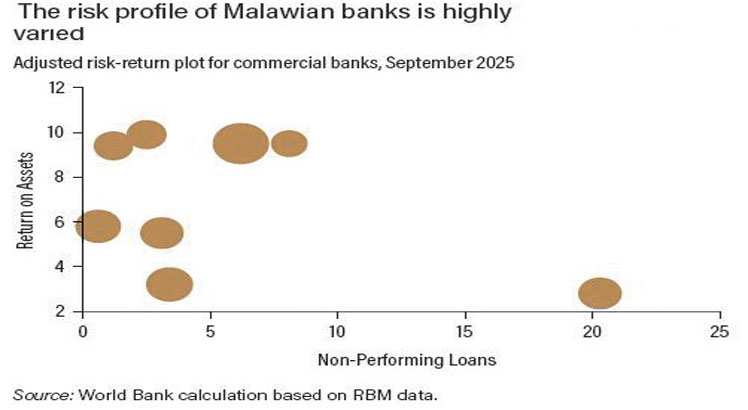
- Return on assets range from 3.2%-9.5%, indicating varied bank performance across Malawi’s sector
- Lower defaults boost banks’ confidence to expand credit, fueling potential private sector growth and stifle the downturn
Despite Malawi’s continued high inflation and protracted period of policy rates hovering at 26%, commercial banks have recorded a marked easing in loan defaults.
Analysis by the World Bank shows the non-performing loan ratio descended to 4.6% by February 2026, from 6.5% the previous year.
That undersides the banking sector’s ability to absorb shocks; RBM’s Financial Stability Report for June 2025 itself noted that local banks maintained adequate impairment reserves above 38% of NPLs.
Economics lecturer Christopher Mbukwa underscores that fewer borrowers struggling to repay allows banks to extend more credit to applicants, with, from his point of view, stable prices and greater confidence as the NPL share dips beneath the traditional five percent threshold.
Nevertheless, Mbukwa emphasizes that continuing inflationary stress demands policy discipline to keep the trend moving in the right direction.
Mzuzu University economics lecturer Christopher Mbukwa opines that the decline demonstrates that the banking sector has weathered challenging times. For lenders, it means fewer customers defaulting, lowering credit risks and allowing them to grant more and gradually more loans, implying better economic conditions and greater customer purchasing power.
"Considering our current scenario with high policy and interest rates, high default would be expected, so the reduction of NPL is important", Mbukwa says. He attributes further driving forces to stable prices and political stability, a business-friendly atmosphere, to sustain improved credit quality.
Financial experts maintain vigilance. John Kapito, at Consumers Association of Malawi, regard the drop as a boon for consumer borrowing capacity.
Lyness Nkungula, CE of the Bankers Association of Malawi, highlights stronger credit risk management, detailed loan monitoring, and active collaboration with borrowers on restructuring troubled loans.
Nkungula explains that the lower NPL ratio frees up resources for productive lending and that the ample risk provision still serves as a safeguard for "further lending vibrancy"into the private sector.
Together with the broad spread of returns on assets between 3.2% and 9.5%, the banking performance reveals both caution and effectiveness within the regulated environment.
"Resilience is there, but further caution is needed to sustain this positive trajectory," she emphasizes.
For local entrepreneurs, lower NPLs suggest banks may be more inclined to offer fresh funding to viable projects. Stability in banking is an important support for the restoration of demographic buoyancy that Malawi’s economy now requires, as it wrestles with high costs of living and service delivery challenges.
Note: This article was summarized using AI technology, with editorial review, from The Nation Online. The full article can be found at: https://mwnation.com/banks-cut-default-rate-below-recommended-level/.
What are your thoughts on this business development? Share your insights and remember to follow us on Facebook and Twitter for the latest Malawi business news and opportunities. Visit us daily for comprehensive coverage of Malawi’s business landscape.


- Montepuez Ruby Mining: A Catalyst for Economic Growth in Malawi - March 5, 2026
- World Bank Identifies Export Barriers Holding Back Malawi’s Growth - March 4, 2026
- Malawi’s Tourism Boom: A K1 Trillion Opportunity for Business Growth! - March 4, 2026