


Key Business Points
- Address foreign exchange gaps by pushing for export diversification and faster mining projects to unlock needed imports and keep factories running at higher capacity.
- Reduce tax burden and policy uncertainty through streamlined regulations and predictable fiscal policies to improve profitability and encourage new investment.
- Adopt local cost‑saving measures such as fuel‑efficient logistics and value‑addition processing to cope with input cost pressures while waiting for macro‑level fixes.
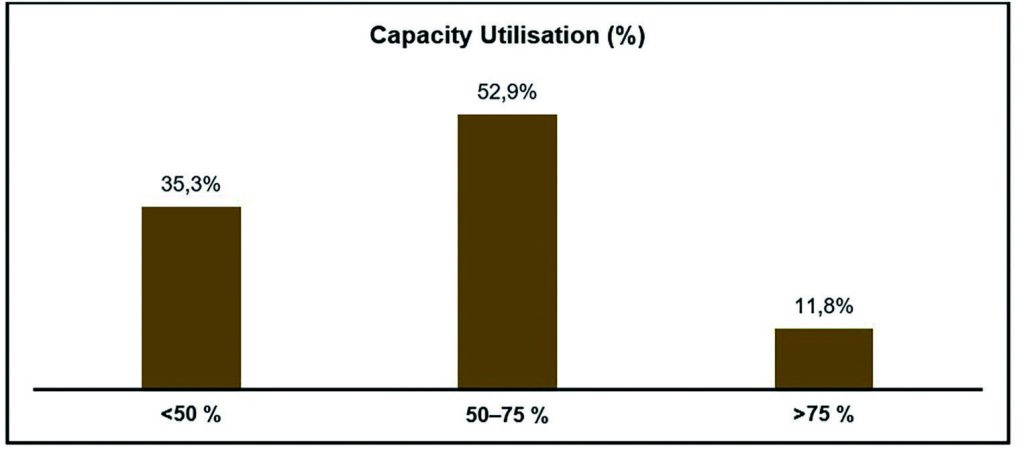
Persistent foreign exchange shortages continued to cripple Malawi’s business environment in the first half of 2026, forcing many businesses to operate at less than half of their capacity. A recent survey by the Malawi Confederation of Chambers of Commerce and Industry (MCCCI) shows that in the first six month of 2026, 35.3 percent of businesses operated at below 50 percent of their production capacity, while 52.9 percent were operating between 50 and 75 percent capacity. Only 11.8 percent of firms were producing at more than 75 percent of their installed capacity, according to the MCCCI’s Economic and Business Review issued last week.
The chamber says the subdued production reflects the difficult operating environment that businesses faced despite some improvements in macroeconomic indicators, including easing headline inflation. Sustained low capacity utilization continues to undermine productivity, increase unit production costs, reduce business profitability, and weaken the competitiveness of Malawian enterprises in both domestic and export markets, states the report.
According to the report, foreign exchange scarcity worsened significantly during the review period, with 88.2 percent of businesses identifying it as their biggest challenge, up from 74.1 percent in 2025. The shortages disrupted imports of raw materials and other essential production inputs, pushing up operating costs and limiting production. The chamber said although concerns over high inflation and rising input costs eased compared to last year, businesses increasingly viewed foreign exchange shortages as the underlying cause of many of their challenges.
MCCCI also cited high taxation among key concerns, with 38.2 percent of firms citing it as a major challenge. Businesses also reported growing concerns over policy uncertainty, fuel shortages and high interest rates. To improve the business climate, MCCCI has urged the government to prioritise restoring foreign exchange availability through export diversification, value addition and accelerated mining development while reducing the cost of doing business.
Economist Marvin Banda described the performance as worrying, saying they expose deep‑seated structural weaknesses in the economy. Banda said persistent foreign exchange shortages would continue to suppress productivity and economic growth if left unresolved.
In response, some entrepreneurs are exploring chithekeso (partnerships) with regional suppliers to share forex resources, while others are investing in umphawi wa kuphatikiza (value addition) to increase the export earnings of raw commodities. Local chambers are also calling for chitetezo cha biashara (business-friendly policies) that simplify customs procedures and lower bureaucratic delays.
By focusing on these steps, Malawian firms can better navigate the current forex squeeze, protect jobs, and position themselves for recovery when external inflows improve. Business leaders are advised to monitor monthly forex allocations from the Reserve Bank, join industry forums to advocate for quicker licensing of mining projects, and consider phased investments in solar power to reduce reliance on costly diesel generators. By maintaining flexible pricing strategies and exploring regional trade agreements, companies can cushion external shocks while building stronger supply chains for the future. Stay informed and proactive for growth.
What are your thoughts on this business development? Share your insights and remember to follow us on Facebook and Twitter for the latest Malawi business news and opportunities. Visit us daily for comprehensive coverage of Malawi’s business landscape.


- Malawi Forestry Investment Opportunities - October 25, 2026
- Malawi’s Fragile Recovery: Business Risks and Opportunities - October 25, 2026
- Streamlining Trade: Malawi & Mozambique Cut Border Delays for Business Growth - October 24, 2026