


Key Business Points
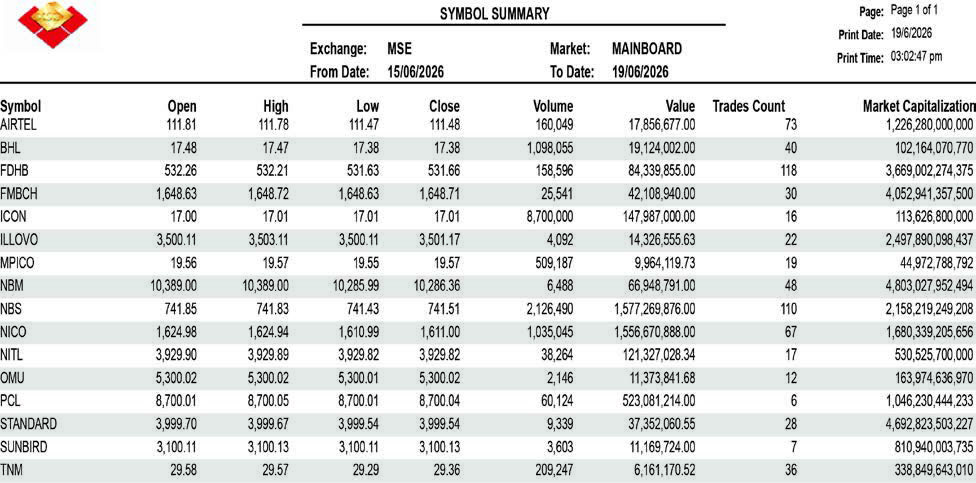
- Market Volatility: Investors should monitor the Malawi Stock Exchange (MSE) trends closely, as the Bearish Index fell 0.26%, signaling cautious investor sentiment.
- Strategic Diversification: Local entrepreneurs are urged to diversify funding sources, balancing stock investments with growth sectors like farming, tourism, or renewable energy.
- Regulatory Watch: Businesses must adapt to evolving policies, ensuring compliance to capitalize on post-election economic stability.
Malawi’s economy is navigating both challenges and opportunities in its post-election phase, with financial markets and sectors reflecting cautious yet dynamic forces. Shareholders of the 16 listed companies on the Malawi Stock Exchange (MSE) faced a grim week last Monday, as the Bearish Index dropped 0.26%, settling at 512,313.54 points from the prior week’s 513,662.33 points. This decline underscores investor uncertainty post-elections, though analysts note that broader economic reforms and infrastructure investments are shaping a gradual recovery.
Malawi’s Financial Landscape
The MSE’s performance mirrors anxieties among entrepreneurs and investors about short-term volatility. While the Bearish Index correction signals pause, the All share index, which tracks market-cap-weighted companies, highlights resilience in high-density sectors. However, experts caution that the stock market’s decline may deter risk-averse investors, pushing them toward alternative ventures. “Diversification is key,” says economic strategist Grace Nyakamchee, stressing that “firms over-reliant on stock markets should explore locally validated businesses in agriculture or SMEs to buffer against market swings.”
Post-Election Opportunities Amid Regulatory Shifts
Malawi’s political landscape is stabilizing after one of Africa’s most contested elections, opening doors for policy-driven growth. President Lazarus Chakwera’s administration has prioritized trade agreements with neighboring countries like Kenya and Zambia, potentially expanding regional supply chains. Entrepreneurs in cross-border logistics and agribusiness—sectors critical to Malawi’s $2 billion textile exports—should prepare to leverage these partnerships. “Mobeyi ya sefumu” (“Do business openly”) is the mantra for those navigating new regulations, which now emphasize transparency and tax compliance to attract foreign direct investment.
Renewables and Agriculture: Growth Catalysts
Renewable energy remains a cornerstone of Malawi’s growth agenda. State-backed projects like the Nyungwe Solar Power Plant, the largest in East Africa, now power industries and residential areas, reducing reliance on hydropower. Investors in solar, wind, or biomass energy—aligned with Malawi’s climate resilience goals—can tap into government grants or public-private partnerships. Similarly, agritech startups are thriving as farmers adopt AI-driven soil analysis tools to boost crop yields amid climate shocks. “Dzachepwe wa chisachafu” (“Seed sower”) refers to innovators transforming Malawi’s agriculture, a sector still reliant on 80% of livelihoods but ripe for modernization.
SMEs and Women-Led Enterprises
Amid macroeconomic headwinds, small and medium enterprises (SMEs) are finding footing through digital platforms. Mobile money services like Airtel Money and Telecel money transfer dominate fintech, enabling cross-border payments for female-led businesses. The rise of WhatsApp-based customer networks—termed “kili chitatu” by local entrepreneurs—shows how small businesses bypass traditional banking bottlenecks. However, limited access to loans remains a hurdle. Community savings groups (“ became*/murundu”) offer an alternative, though formalizing these structures could unlock higher capital infusion.
Tourism and Cultural Capitalization
Malawi’s natural and cultural assets remain underutilized yet promising. Lake Malawi’s biodiversity and UNESCO World Heritage Sites draw global ecotourism interest. The government’s “Malawi 2063” vision includes eco-lodges and heritage trails, offering partnerships for hospitality chains. Investors like Dubai’s Nakhalani Group, who recently toured the Lake Malawi region, signal growing offshore appetite. “Mali mwa thyolo” (“tourism currency”) gains traction as stakeholders prioritize sustainable travel over extractive models.
Looking Ahead: Balancing Risk and Reward
While the MSE’s slump highlights market fragility, Malawi’s entrepreneurs are increasingly adopting adaptive strategies. Agri-tech innovators, for instance, report a 30% uptick in crop export partnerships with EU nations, driven by demand for organic legumes. Similarly, the renewable energy sector’s 12% growth in private investments Q2 2024 reflects green incentives. For business leaders, the message is clear: stay agile, align with FDI-boosting policies, and anchor ventures in Malawi’s rich human and environmental capital. As Minister of Industry Juliet Canaga notes, “Navigating this landscape requires boldness, but the rewards are written in Malawi’s resources.”
Practical pathways for businesses include:
- Leverage tax breaks: Under the 2024 Economic Growth Strategy, SMEs in renewable energy and agro-processing receive up to 20% corporate tax rebates.
- Expand digital adoption: Use WhatsApp Business Platform to streamline operations, as seen in Blantyre’s restaurant hubs.
- Collaborate regionally: Tap Trade Preferences under EDDWA (East African Development Bank) initiatives to access cheaper loans.
The road ahead demands blending Malawi’s entrepreneurial spirit with pragmatic moves—balancing local ingenuity (“dhidhi la Malawi”) with global market trends. As the MSE stabilizes, businesses that root their strategies in these insights will shape the nation’s economic narrative.
What are your thoughts on this business development? Share your insights and remember to follow us on Facebook and Twitter for the latest Malawi business news and opportunities. Visit us daily for comprehensive coverage of Malawi’s business landscape.


- Lindian, French Firm Anchor Technology Deal to Elevate Malawi Economy - September 24, 2026
- Economic Positivity Gains Momentum as Inflation Pressures Ease - September 23, 2026
- Malawi Businesses Set to Gain from K3.4 Trillion Economic Stimulus - September 23, 2026