


Key Business Points
- Malawi’s trade deficit surged 129% year-on-year in January 2026 to $336.6 million, driven by rising imports outpacing declining exports
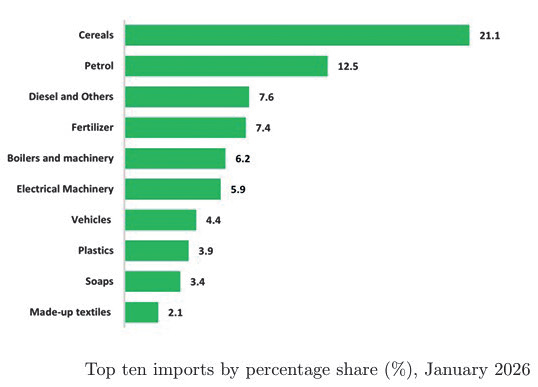
- Imports climbed 42.8% to $390.7 million, with cereals, fuel, and manufactured goods accounting for over 70% of total import value
- Tobacco remains Malawi’s top export at $35.8 million, but national over-reliance on few primary commodities weakens export earnings and economic competitiveness
Malawi’s trade deficit widened by 129 percent in January 2026 to $336.6 million (about K589 billion), according to preliminary figures from the National Statistical Office (NSO). The rise contrasts with a deficit of $146.8 million (about K257 billion) in January 2025, reflecting faster growth in imports than in exports.
NSO data shows total exports reached $54.1 million (about K94.7 billion) in January 2026, up 57.3 percent on the $126.7 million (about K221.8 billion) recorded in January 2025. Despite the increase in export value, the sharp rise in imports has widened the gap. Imports climbed 42.8 percent to $390.7 million (about K684 billion) from $273.5 million (about K478.8 billion).
At current levels, exports cover only 14 percent of imported goods – an export-to-import ratio of 0.14. Tobacco, pulses and tea accounted for over 83 percent of total export earnings last month. By contrast, the top 10 imports – led by cereals (over $82 million), petrol (nearly $49 million) and diesel (over $29 million) – accounted for nearly three-quarters of total import expenditure.
The figures point to a deeper, continuing structural problem in Malawi’s external trade. In 2025, the annual trade deficit widened by 15 percent to $2.67 billion (about K4.6 trillion), up from $2.2 billion (about K3.8 trillion) in 2024. Over that year, exports were $3.2 billion (about K5.6 trillion), while imports were $900 million (about K1.5 trillion), leaving a gap of $2.3 billion (about K4 trillion).
Local economists see this trend as reflecting years of dependence on under-performing primary commodities with little diversification into higher-value or processed goods. University of Malawi economics lecturer Edward Leman points to the country’s long-standing reliance on tobacco and intermittent moves toward diversification and value addition.
Mzuzu University economist Christopher Mbukwa links the deficit to both structural and transactional weaknesses, noting that exports of tobacco, groundnuts and tea have fallen, while kwacha-denominated transactions have shifted away from the traditional dollar-basis for cross-border trade.
Export Development Fund managing director Frederick Chanza argues the deeper issue is limited domestic industrial scale. Malawian exports have generally been raw commodities, while the country imports expensive finished goods and intermediate inputs.
As part of efforts to narrow the deficit, the Export Development Fund has launched initiatives to support industrial parks, mining projects and high-value processing. Meanwhile, Malawi’s National Export Strategy II, seeks to shift away from raw exports and build domestic capacity to manufacture value-added products for export.
The draft figures from last month underline the urgency of translating those policies into larger volumes of competitive, diversified exports – otherwise, growing deficits will continue to strain the economy.
Mphoyola yomwe a Malawi amalipira kugwira pa intaneti ndi $3.80 kukhala osankha ndi ogwira ntchito osacekuka
Kuhala koyenda panjara utsogoleri wapachibale panja aphungu 11 asadabwele motchuka
Musandifunse kalombwana iyelekeza banja lathu chivute chifukwa chikhoţi
Mutharika anzanga ndi mnyamata waulimi.
samala wakapeya wozza i poganarini kaa sowa ingopa
What are your thoughts on this business development? Share your insights and remember to follow us on Facebook and Twitter for the latest Malawi business news and opportunities. Visit us daily for comprehensive coverage of Malawi’s business landscape.

