


Key Business Points
- Strengthen export earnings to reduce the widening trade deficit caused by rapid malo kwambiri; diversify away from overreliance on tobacco and tea.
- Pursue strategic investments in ku amasankha, mining, and import substitution to stabilize currency earnings and boost sector growth.
- Adapt to policies such as the recent staple food maize flour, fresh milk, rice, and fruits import ban and focus on adding value to domestic products rather than exporting raw materials.
Malawi’s trade deficit widened significantly in the first eight months of this year, according to new data from the National Statistical Office. Between January and August, the gap between imports and exports reached $2 billion, signaling a tough environment for local businesses relying on trade stability.
The deficit widened by 8.9 percent compared to the same period last year. Imports surged by 14 percent to $2.7 billion, far outpacing the increase in exports, which only reached $699.4 million. This mismatch has squeezed local markets and raised concerns about lasting economic sustainability.
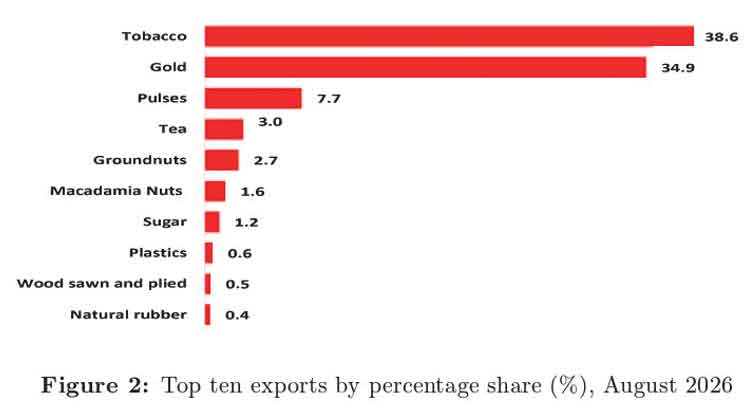
However, the situation improved slightly in August. The monthly trade deficit narrowed by 8.8 percent to $197.5 million, driven by stronger export earnings, particularly from gold valued at $53.4 million. Over the past year, total exports jumped 38.2 percent, while imports rose 7.1 percent. Experts note that exports now make up 43.7 percent of the value of malo kwambiri, though still insufficient to close the gap.
For decades, Malawi has depended heavily on traditional crops like tobacco, groundnuts, and tea for currency earnings. Yet, export growth remains concentrated in just four commodities, accounting for over 91 percent of total exports. Meanwhile, imports remain heavily weighted toward fuel and machinery, accounting for 61.6 percent of all imports. This imbalance exposes critical vulnerabilities in the economy.
University of Malawi economics lecturer Edward Leman noted that ku amasankha has often remained a stated goal rather than a realized strategy. He warned that relying solely on traditional crops leaves the national market edge fragile and makes Malawi increasingly dependent on imported goods. Mzuzu University lecturer Christopher Mbukwa pointed out that the drop in sales of tobacco, groundnuts, and tea directly causes the widening deficit.
To fix these issues, trade expert Paul Kwengwere urged strategic investment in mining and import substitution. He specifically highlighted organic fertiliser plants as a crucial import to replace. Moving from raw products to refined goods and textiles can also multiply currency earnings without needing more land.
Despite the Ministry of Industrialisation acknowledging that current trade terms align with their National Export Strategy II, the deficits continue to accumulate. This underscores a need for faster execution of diversification plans. Furthermore, the recent import ban on maize flour, fresh milk, rice, and fruits continues to disrupt both local markets and suppliers. Local entrepreneurs must stay agile, viewing this data as a call to action to build resilient, diversified, and locally valuable businesses.
What are your thoughts on this business development? Share your insights and remember to follow us on Facebook and Twitter for the latest Malawi business news and opportunities. Visit us daily for comprehensive coverage of Malawi’s business landscape.


- Malawi’s Trade Deficit Widens 9% in 8 Months: Implications for Business and Investment - October 30, 2026
- Stock Exchange Charts Course With Regulators on Performance - October 30, 2026
- Malawi Construction Costs Drop, Opening New Investment Doors - October 30, 2026