
Fueling Malawi’s Business Growth: Financing Ideas That Drive Impact
Key Business Points
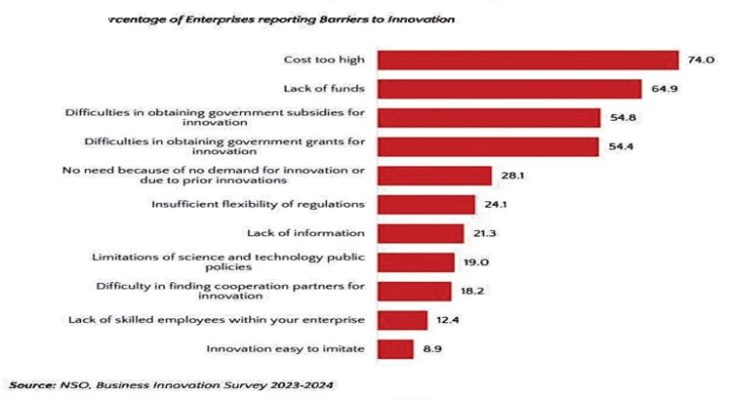
- Financing gap limits growth — Only 13.3 percent of firms accessed public innovation funds while 57.1 percent still managed to innovate
- Information barrier is solvable — 58.4 percent of businesses missed funding due to lack of awareness not eligibility
- Sector opportunities vary — Information and communication leads at 97.3 percent innovation rate while professional services lag at 37.1 percent
Malawi’s first Business Innovation Survey reveals a determined private sector advancing despite structural constraints. Conducted jointly by the National Statistical Office and National Commission for Science and Technology the study captures enterprise activity between 2023 and 2024. The findings paint a picture of resilience where mabizinesi large and small pursue new products services and processes with limited formal support.
Phillip Nyoni director general of the National Commission for Science and Technology described the results as evidence of both ingenuity and systemic bottlenecks. He emphasized the report should function as a practical instrument for policy action aligned with MW2063 pillar two which envisions a vibrant knowledge based economy. The long term strategy targets lower middle income status by 2030 and upper middle income by 2063.
Shelton Kanyanda commissioner of statistics at NSO called the survey a significant step toward scientifically driven economic growth. The primary objective was to establish baseline data for monitoring innovation progress across the business sector. This baseline will help track whether future interventions move the needle.
The numbers tell a nuanced story. While 75.3 percent of enterprises identify innovation as a strategic priority only 36.7 percent maintain a formal innovation strategy. Even fewer at 24.6 percent allocate a dedicated budget for innovation activities. This gap between intent and structure suggests many firms rely on ntchito yosiyanasiyana or ad hoc approaches rather than planned investment.
Access to public financing remains the sharpest constraint. Just 13.3 percent of enterprises received public financial support for innovation. Among those who did not 58.4 percent cited lack of information as the primary reason. Another 22.5 percent pointed to complex application procedures. These are addressable barriers. Better outreach simpler forms and clearer guidance could unlock participation without new funding.
Sector performance varies widely. The information and communication sector recorded 97.3 percent innovation activity. Mining and quarrying followed at 84.2 percent and manufacturing at 74.1 percent. Professional scientific and technical activities trailed at 37.1 percent. For entrepreneurs this signals where chuma or capital might flow and where partnership opportunities exist.
The survey also highlights low levels of research and development investment limited intellectual property commercialization and fragmented institutional support. Many firms operate in the informal space where ganyu and katapila dynamics dominate. Bringing these enterprises into formal innovation ecosystems requires tailored approaches not one size fits all solutions.
For business owners the message is clear. Innovation is happening across Malawi often without formal strategy or public backing. Firms that formalize their approach allocate budgets and tap available support gain competitive advantage. Industry associations and business development service providers can bridge the information gap by disseminating funding opportunities and simplifying application guidance.
Policy makers now have empirical evidence to design targeted interventions. The survey creates accountability for both government and private sector to track progress. As Malawi pursues its MW2063 vision innovation must shift from survival tactic to strategic driver. The data is now available. The next move belongs to those ready to act.
What are your thoughts on this business development? Share your insights and remember to follow us on Facebook and Twitter for the latest Malawi business news and opportunities. Visit us daily for comprehensive coverage of Malawi’s business landscape.

- Malawi’s Fragile Recovery: Business Risks and Opportunities - October 25, 2026
- Streamlining Trade: Malawi & Mozambique Cut Border Delays for Business Growth - October 24, 2026
- Maize Prices Edge Up in September: Market Analysis for Malawi Investors - October 24, 2026