
EU Extends Trade Deal, Giving Malawi Businesses Fresh Growth Avenues
Key Business Points
- EU GSP extension (2026‑2036) gives Malawi another decade of duty‑free access to the world’s largest export market, creating a stable platform for growth.
- 19 % rise in GSP use (2022‑2024) boosted Malawi’s EU exports by 13 %, especially in clothing, footwear, fish and chemicals – an opportunity for local producers to expand.
- Addressing rules of origin and non‑tariff barriers is essential; manufacturers must align with EU standards and the Ministry should simplify procedures to fully capture the 99 %+ utilization potential.
Malawi’s trade outlook received a fresh boost when the European Union announced the renewal of its Generalised Scheme of Preferences (GSP) for the period 2026‑2036. The extension means that, starting 1 January 2027, the Everything But Arms (EBA) tariff line will continue to grant duty‑free entry to EU markets for Malawi and 45 other developing nations. This move reinforces the EU’s commitment to stable and predictable trade relations, especially at a time of global geopolitical tension.
Data from the EU’s GSP hub show that Malawi’s utilization of the scheme has been on an upward trajectory. Between 2022 and 2024, the country recorded a 19 % increase in GSP utilization, which translated into a 13 % rise in total exports to the EU. The most dynamic sectors are clothing, footwear, fish and chemical products, all of which are eligible under the EBA scheme. For local entrepreneurs, this signals a clear chance to tap into a market that already accepts over 99 % of Malawi’s eligible shipments.
The EU’s statement highlights that the GSP is more than a trade instrument; it is a lever for sustainable development, encouraging improvements in human rights, labour standards, environmental protection and the rule of law. For Malawi’s business community, this means that meeting quality and regulatory expectations can unlock not only market access but also development assistance and technical support.
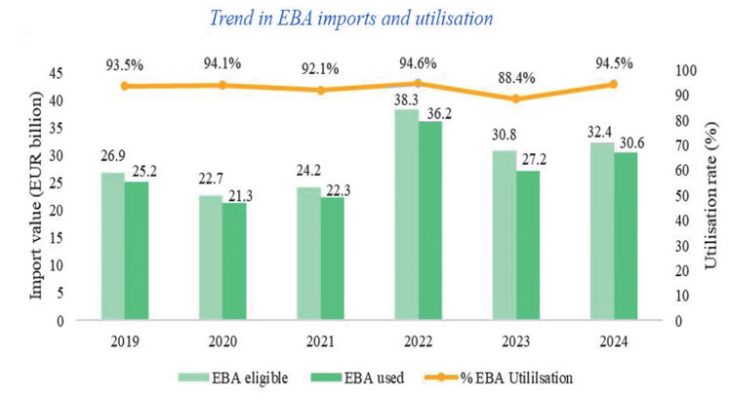
However, the path to maximizing these benefits is not without obstacles. According to Alick Nyasulu, an economist based in Asia, Malawi’s tough business environment hampers full exploitation of trade agreements. He urges manufacturers to understand foreign market demands and to invest in quality improvements. The Ministry of Industrialisation, Business, Trade and Tourism’s Principal Secretary, Wiskes Nkombezi, echoed this sentiment, emphasizing the need to tackle tariffs, stringent rules of origin and non‑tariff barriers. Streamlining these areas would help Malawi capture the 88.9 % global utilization rate observed among EBA beneficiaries in 2024.
Exports to the EU remain modest but strategically important. Agricultural products dominate, accounting for up to 99 % of Malawi’s EU shipments, with tobacco representing the bulk of that volume. Meanwhile, 95 % of EU imports into Malawi are industrial goods such as machinery, chemicals and paper products. This asymmetry underscores the potential for value‑addition within Malawi – processing raw agricultural goods could increase export earnings and reduce reliance on raw commodity sales.
The renewed GSP provides a clear timeline for businesses to prepare. Companies are advised to:
- Verify that their products meet EBA eligibility criteria.
- Invest in certification and quality control to satisfy EU standards.
- Engage with the Ministry’s trade facilitation units to clarify rules of origin and other procedural requirements.
For Malawi’s entrepreneurs, the next decade offers a golden opportunity to diversify export markets, increase product value, and integrate into global supply chains. By leveraging the extended GSP and addressing existing trade barriers, the nation can turn this policy advantage into tangible economic growth, creating jobs and fostering a more resilient business ecosystem.
What are your thoughts on this business development? Share your insights and remember to follow us on Facebook and Twitter for the latest Malawi business news and opportunities. Visit us daily for comprehensive coverage of Malawi’s business landscape.

- Streamlining Trade: Malawi & Mozambique Cut Border Delays for Business Growth - October 24, 2026
- Maize Prices Edge Up in September: Market Analysis for Malawi Investors - October 24, 2026
- IPMM Demands HR Bill Passage to Stabilize Malawi’s Labour Landscape - October 23, 2026