
Malawi’s Income Gap: Key Insights for Business Leaders
Key Business Points
• Malawi’s extreme poverty levels with average monthly incomes under €130 severely limit domestic market purchasing power, constraining business growth prospects for local entrepreneurs and requiring focus on export-oriented or informal sector opportunities.
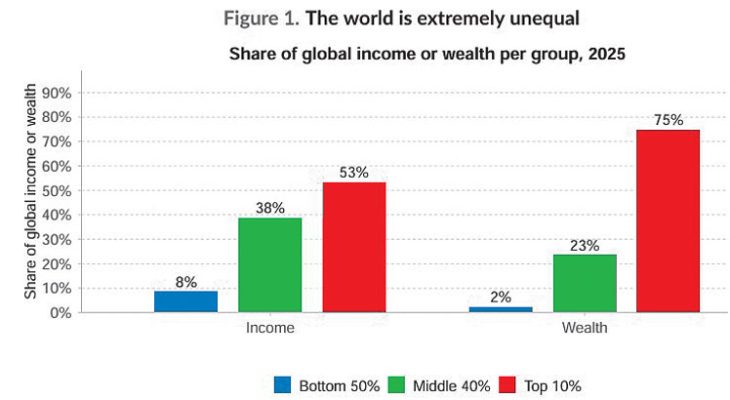
• Severe wealth inequality sees the top 10 percent capturing 55-57 percent of income while the poorest half earn only 8-11 percent, creating a narrow middle class and limiting sustainable consumer demand for businesses.
• Persistent high inflation continues eroding household incomes and purchasing power, forcing businesses to adapt pricing strategies and governments to prioritise economic stabilisation reforms for improved investment climate.
Malawi’s Economic Challenges Deepen Business Environment Concerns
Malawi remains one of the world’s poorest nations, with average monthly household incomes below €130 (approximately K261,000), significantly trailing the Sub Saharan African average of €300 (K603,000). This stark reality, revealed in the 2026 World Inequality Report, presents ongoing challenges for local businesses struggling to expand within a constrained domestic market.
The report, supported by the United Nations Development Programme and European Union, ranks Malawi among the poorest large countries globally, alongside nations like Burundi and Somalia. At the global level, monthly incomes average €1,300, highlighting the extreme disparities that affect Malawi’s economic potential.
Within Malawi, inequality remains deeply entrenched. The bottom 50 percent of earners receive just eight to 11 percent of national income, while the top 10 percent captures 55 to 57 percent. Alarmingly, the richest one percent earns more than double what the poorest half combined receives, according to the World Inequality Lab.
Ricardo Gómez Carrera, lead researcher, emphasises that such inequality stems from political choices rather than inevitability. He advocates for progressive taxation to fund public services like education, which he describes as "the closest thing we have to a universal equaliser."
These findings emerge alongside Malawi’s newly revised minimum wage framework. Effective June 1 2026, domestic workers will earn K83,720 (€42) monthly, up from K72,800 (€36), while commercial workers’ minimum wage increased to K157,500 (€78) from K126,000 (€63). However, these adjustments may offer limited relief if inflation continues eroding real wages.
Economic governance expert Agnes Nyirongo warns that Malawi’s worsening macroeconomic instability threatens ordinary citizens’ welfare. High inflation acts as a "hidden tax on the poor," she explains, urging immediate reforms to stabilise the economy and support income growth. Without intervention, she cautions, living standards will keep declining.
For Malawi’s business community, these trends signal a challenging operating environment. Enterprises must navigate shrinking consumer bases while planning amid volatile economic conditions. Opportunities may lie in export markets, informal sector innovation, or businesses serving the emerging urban middle class.
The government faces pressure to implement structural reforms addressing both inflation and inequality. Investment in education and public infrastructure could expand the economic pie while improving living standards critical for sustainable domestic demand.
Despite these obstacles, Malawi’s businesses continue operating within a resilient informal economy that provides livelihoods for millions. Success stories exist in sectors like agriculture processing, telecommunications, and smallholder farming, suggesting pathways toward inclusive growth even amid significant structural challenges.
What are your thoughts on this business development? Share your insights and remember to follow us on Facebook and Twitter for the latest Malawi business news and opportunities. Visit us daily for comprehensive coverage of Malawi’s business landscape.

- Malawi Debt Restructuring Paves Path for Business Growth - September 20, 2026
- Mwapata Institute Maps Profitable Pathways in Malawi’s Soybean Value Chain - September 20, 2026
- TNM Introduces Tailored Packages to Elevate Malawi Business Performance - September 20, 2026