
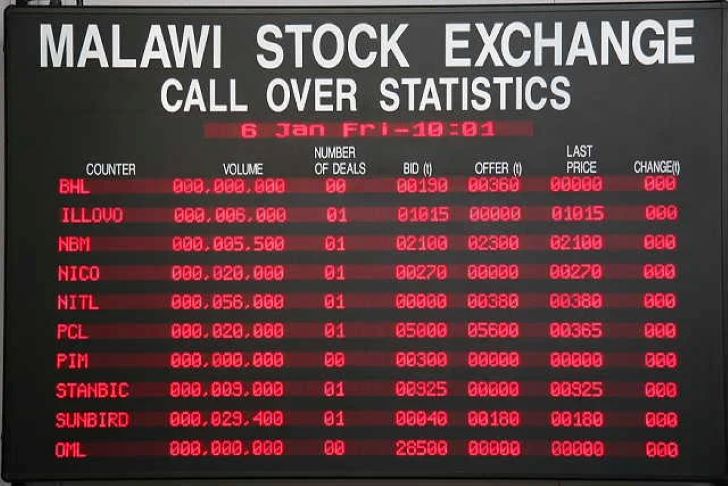
Malawi Stock Exchange Plunges K1.3 Trillion in Q3 as Bear Market Intensifies
Key Business Points
- The Malawi Stock Exchange fell 6.4% in the third quarter, wiping out K1.3 trillion in market value.
- Uncertainty over tax policy and a proposed debt restructuring is weighing on investor sentiment.
- Business leaders should explore alternative funding and focus on local market strengths.
The Malawi Stock Exchange (MSE) fell in the third quarter of 2026, with the index down 6.4 percent and market capitalization shrinking to K27.2 trillion from K28.5 trillion at the end of June. This drop, equivalent to a loss of K1.3 trillion, marks a downward trend that has seen the year to date return reach negative 16.72 percent. Analysts describe the move as a market correction, yet they caution that the decline in valuation does not necessarily reflect weaker fundamentals among listed firms.
Capital market analyst Benedict Nkhoma noted that the broad based sell off across thirteen counters signals that investors are reassessing risk amid growing economic and policy uncertainties. He explained that the reduction in market capitalization is a valuation change rather than a cash outflow, but the sentiment is being driven by concerns over taxation and the government’s proposed domestic debt restructuring program. The initial proposal of a 30 percent capital gains tax was later replaced by a two percent final withholding tax, but the uncertainty persists.
Equity Masters Limited board member Purity Chitalo argued that the current downturn exceeds a normal correction, characterizing it as a bear market. She pointed out that forced selling by large institutional investors, including pension funds and life insurers, has created a persistent supply of shares with limited buyers. Chitalo warned that listed banks, which are major components of the MSE, could feel the impact first.
Stockbrokers Malawi Limited equity investment analyst Kondwani Makwakwa attributed the decline to a shortage of buyers coupled with increased selling pressure as investors seek to lock in profits. The combination of policy uncertainty and debt restructuring plans has led many market participants to adopt a wait and see approach.
The situation presents both challenges and opportunities for Malawi’s business community. Policy uncertainty remains a key risk, but it also creates a chance for entrepreneurs to innovate and fill gaps left by retreating investors. The government’s effort to reprofile domestic debt could alter the landscape for banks and insurers, potentially opening investment opportunities in sectors less exposed to sovereign risk.
Local business owners are advised to consider diversifying revenue streams, strengthening cash reserves, and exploring alternative financing options such as private equity or regional partnerships. The Mphamvu of the market, or its capacity to generate value, may be tested in the coming months, but resilient firms that adapt to the new environment could emerge stronger.
The government’s plan to restructure domestic debt, if implemented transparently, could lower borrowing costs for local firms and encourage investment in priority areas such as agriculture and manufacturing, thereby supporting broader economic expansion. Such measures would also enhance confidence among investors and could lead to a recovery in stock market valuations.
As the year progresses, stakeholders will monitor the outcome of the debt restructuring negotiations and any subsequent legislative changes. The MSE’s performance will likely remain a barometer for the broader economic growth trajectory, and careful navigation of the current headwinds could position Malawi’s enterprises for future success. Adaptation remains essential for growth.
What are your thoughts on this business development? Share your insights and remember to follow us on Facebook and Twitter for the latest Malawi business news and opportunities. Visit us daily for comprehensive coverage of Malawi’s business landscape.
