
Maximize Sugar Profits: Closing the Domestic Export Price Gap
Key Business Points
- Domestic sugar prices remain 85 percent higher than export prices, forcing local mwanzeru to pay more for basic supplies due to limited competition and strict government import policies.
- The weak kwacha and high operational costs are crippling local production, as millers must buy foreign currency on the black market, making Malawi’s sugar expensive to produce globally.
- Local businesses must advocate for cheaper power and transport costs if Malawi wants to lower sugar prices while protecting jobs and maintaining a stable forex earnings stream.
Malawi’s domestic sugar prices continue to outpace export prices, a significant gap that a new joint study by the Common Market for Eastern and Southern Africa (Comesa) and the University of Johannesburg attributes to market conditions and government policies. The analysis clearly reveals that limited competition has kept local sugar prices about 85 percent higher than export prices over recent years.
The report, involving the Competition and Fair Trading Commission, says foreign currency shortages and the severe depreciation of the kwacha have constrained access to imported sugar and vital production inputs. Most authorized sugar imports come from Comesa and Southern African Development Community markets, where traders benefit from duty waivers, which is significantly shaping the pricing dynamics of the domestic market.
Under the strict Control of Goods Act, sugar imports require government permits and are generally allowed only when local millers cannot meet domestic demand. This strict regulation limits the entry of competing regional supplies. The Sugarcane Industry Act further establishes a comprehensive legal regime to strictly regulate the growing, manufacturing, and marketing of sugar. Currently, Malawi has two main producers operating locally: listed company Illovo Sugar (Malawi) plc and State-owned Salima Sugar Company.
Illovo Sugar (Malawi) plc managing director Ronald Ngwira recently addressed the issue, stating that the challenge lies in the exchange rate used to reach these conclusions. He noted that because the company cannot source its inputs at the official rate, its production costs remain high. "Most businesses are sourcing materials at around K3 600 to K3 800 to the dollar, which makes the cost of production in Malawi the highest," he explained. He added that at the parallel exchange rate, Malawian sugar remains the cheapest compared to neighbors.
John Kapito emphasized that Malawi must first address high production costs, including electricity, interest rates, and transport. "We would appreciate lower sugar prices, but Malawi must first address the high cost of production, including electricity, interest rates and transport, if local sugar is to become more affordable," he said. Opening the market could lower prices for consumers but risks jobs and crucial forex earnings.
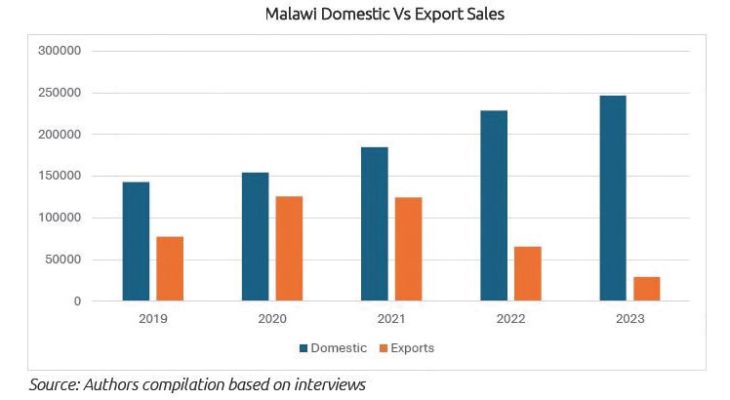
Domestic consumption rose from 142 716 metric tonnes (MT) in 2019 to 246 432MT in 2023, before declining to 227 017MT in 2024. During the same period, exports fell sharply from 125 546MT in 2020 to 29 449MT in 2023 as domestic demand increased and severe climate-related shocks impacted production.
Centre for Social Concern economic governance programme officer Agnes Nyirongo observed that Malawi must build a robust sugar industry capable of satisfying domestic demand at competitive prices while allowing alternative supplies when necessary. As the Ministry of Industry, Trade, Digitisation and Tourism weighs how to protect local industries while shielding consumers, the practical path forward remains clear for mwanzeru who need reliable supply and fair pricing to thrive.
What are your thoughts on this business development? Share your insights and remember to follow us on Facebook and Twitter for the latest Malawi business news and opportunities. Visit us daily for comprehensive coverage of Malawi’s business landscape.

- Maximize Sugar Profits: Closing the Domestic Export Price Gap - September 27, 2026
- RBM Forex Controls: Hidden Risks for Malawi’s Business Landscape - September 27, 2026
- Rising Tax Costs Squeeze Malawi Business Margins, Warns World Bank - September 27, 2026