
Foreign Exchange Shortage Continues to Hamper Business Growth—MCCCI
Key Business Points
- Diversify suppliers to lower dependence on foreign exchange shortages.
- Monitor tax changes and engage with officials to shape policy that supports growth.
- Explore local alternatives for fuel and raw materials to cut import costs.
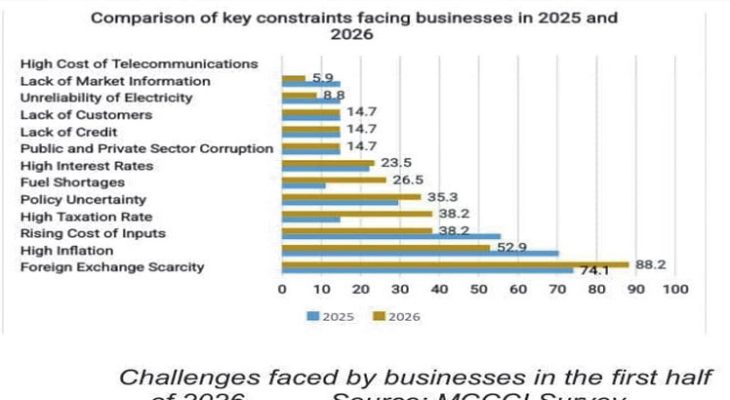
The Malawi Confederation of Chambers of Commerce and Industry released its First Half 2026 Economic and Business Review which paints a stark picture of the nation’s private sector. Foreign exchange scarcity emerged as the top obstacle for 88.2 percent of firms, climbing from 74.1 percent a year earlier. The shortage forces companies to delay inputs, raise production costs and cut output. At the same time inflation pressure eased allowing the share of businesses naming price increases as a chief concern to fall from 70.4 percent to 52.9 percent. Yet tax burdens grew sharply, with 38.2 percent of respondents flagging higher levies as a major hurdle compared to just 14.8 percent previously. Fuel supply woes also surged, as firms reporting shortages jumped from 11.1 percent to 26.5 percent.
Capacity utilisation data reveal that only 11.8 percent of companies operate above 75 percent of installed capacity. The majority, 52.9 percent, run at half to three quarters of capacity, while 35.3 percent produce less than half of what they could. This under use drives up unit costs and weakens competitiveness. The chamber warns that persistent low utilisation could erode jobs and limit export potential.
Minister of Industrialisation, Business, Trade and Tourism Simon Itaye outlined government steps to curb foreign exchange leakages as a term fix. He highlighted a longer term plan focused on import substitution and export diversification to grow foreign currency inflows. Meanwhile Reserve Bank of Malawi senior economist Whytone Jombo admitted that allocating forex to essential sectors such as pharmaceuticals and fuel remains a struggle due to limited reserves. Malawi needs roughly $250 million each month for critical commodities.
Given these dynamics, entrepreneurs can consider a few moves. First, source inputs locally where possible to reduce exposure to forex gaps. Second, formalise tax dialogues with the Ministry of Finance to stay ahead of policy shifts. Third, invest in fuel efficient machinery or alternative energy sources to mitigate supply interruptions. By aligning operations with government priorities, businesses can position themselves to benefit from any easing of the monetary squeeze.
These insights suggest that proactive adaptation and strategic engagement can turn current constraints into new opportunities for growth and resilience. Entrepreneurs should also monitor the central bank’s policy reviews, as adjustments to interest rates can affect borrowing costs and investment decisions. Engaging with local industry associations can provide early alerts on regulatory changes and open doors to joint lobbying efforts. Moreover, leveraging digital platforms to track currency rates and market prices can help businesses optimise procurement and pricing strategies. By staying informed and agile, firms can turn the present challenges into a catalyst for innovation and expansion. Finally, consider partnering with community groups that promote local value chain development. Such collaborations can unlock access to raw material supplies that are less exposed to foreign exchange limits and can also enhance brand reputation among consumers who value home grown solutions. Embracing these relationships may also position your enterprise to qualify for incentives aimed at boosting production and export readiness. Such partnerships strengthen supply chain resilience, making firms better equipped to absorb shocks now in market today globally speaking.
What are your thoughts on this business development? Share your insights and remember to follow us on Facebook and Twitter for the latest Malawi business news and opportunities. Visit us daily for comprehensive coverage of Malawi’s business landscape.

- Streamlining Trade: Malawi & Mozambique Cut Border Delays for Business Growth - October 24, 2026
- Maize Prices Edge Up in September: Market Analysis for Malawi Investors - October 24, 2026
- IPMM Demands HR Bill Passage to Stabilize Malawi’s Labour Landscape - October 23, 2026