
Malawi’s Import Burden Swells: 20% Trade Deficit Surge in 11 Months Poses New Challenges for Local Businesses
Key Business Points
- Malawi’s trade deficit has increased by 20% to $2.4 billion (about K4.2 trillion) in the 11 months to November, driven by a surge in imports and a decline in exports.
- The country’s exports, which include tobacco, tea, and pulses, have decreased by 26.7% in November 2025 compared to the same period last year, while imports have increased by 15.6% during the same period.
- To address the trade deficit, experts emphasize the need for export diversification, value addition, and efficient repatriation of export proceeds, as well as building scale in production to reduce reliance on importing expensive finished products.
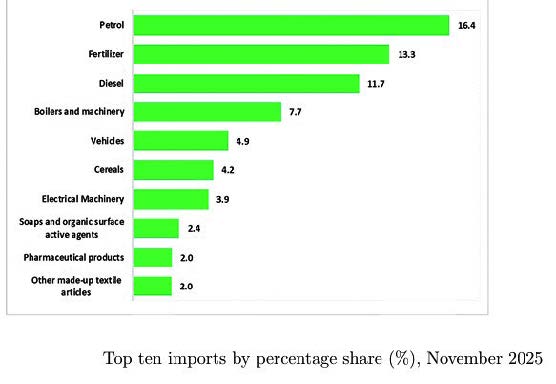
Malawi’s trade deficit has widened significantly, with the latest data from the National Statistical Office (NSO) showing a 20% increase to $2.4 billion (about K4.2 trillion) in the 11 months to November. This is attributed to a surge in imports, which rose to $3.27 billion (about K5.7 trillion) from $2.91 billion (about K5 trillion) during the same period last year, while exports peaked at $875.4 million from $882.8 million (about K1.5 trillion) in 2024. The trade gap widened to $238.9 million (about K418 billion) in November alone, with imports comprising fuel, fertiliser, and pharmaceuticals continuing to dwarf exports.
According to Mzuzu University economics lecturer Christopher Mbukwa, the widening trade deficit reflects both structural and transactional weaknesses in the economy. He attributes the increase in the trade deficit to the drop in sales of tobacco, groundnuts, and tea, as well as transactions being done in kwacha this year as opposed to traditional dollar transactions. Despite the widening trade gap, Malawi’s foreign exchange reserves slightly improved in October 2025, standing at $526.8 million (about K921 billion), equivalent to 2.1 months of import cover.
However, Scotland-based Malawian economist Velli Nyirongo notes that the increase in reserves does not reflect an underlying recovery in export performance. He emphasizes the need for export diversification, stronger value addition, and efficient repatriation of export proceeds to boost the country’s exports. Export Development Fund managing director Frederick Chanza agrees, stating that the core weakness is not merely weak export receipts, but the country’s chronic failure to produce at scale. He highlights the importance of building scale in production, particularly in industrial parks, mining projects, and high-value processing, to restructure trade and narrow the deficit.
The Malawi Government’s import ban on certain goods, including maize flour, fresh milk, rice, and fruits, has not seemed to have a significant impact on reducing imports. In fact, imports continue to surge, with the country importing goods worth $3 billion (about K5.2 trillion) against exports at $1 billion (K1.7 trillion) last year, creating a $2 billion (K3.5 trillion) deficit. As the country looks to address its trade deficit, zinthu zofunika (things that are necessary) for businesses and entrepreneurs to consider include diversifying their exports, adding value to their products, and building scale in production to reduce reliance on importing expensive finished products. By doing so, Malawi can work towards kugawa ndi ulere (reducing the deficit) and promoting economic growth.
What are your thoughts on this business development? Share your insights and remember to follow us on Facebook and Twitter for the latest Malawi business news and opportunities. Visit us daily for comprehensive coverage of Malawi’s business landscape.

- Malawi Debt Restructuring Paves Path for Business Growth - September 20, 2026
- Mwapata Institute Maps Profitable Pathways in Malawi’s Soybean Value Chain - September 20, 2026
- TNM Introduces Tailored Packages to Elevate Malawi Business Performance - September 20, 2026