
MW Exports Plunge Amid US Tariff Shifts: What It Means for Your Business
Key Business Points
- US tariffs cut Malawi’s tea exports by 79%, sugar by 66%, and tobacco by 53%, threatening earnings from key agricultural products
- Agoa preferences may be restored through December 2026, offering renewed duty-free access amid high global tariff uncertainty
- Limited export diversity and heavy dependence on US markets put Malawi’s trade position at risk; broader market access and value-addition are now critical
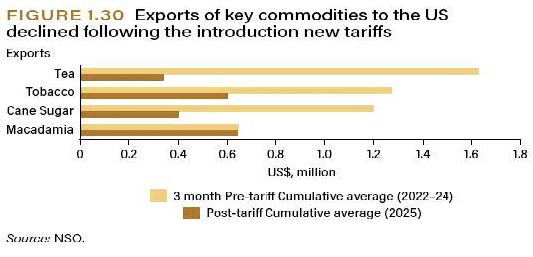
Malawi’s export earnings are facing a sharp drop after the United States imposed new duties on the country’s top export goods. According to World Bank data, shipments of tea tumbled by 79 percent, cane sugar fell by 66 percent, and tobacco dropped by 53 percent compared to the same months in 2022/24. The fall comes on top of Agoa’s temporary lapse in September, which lifted preferential duty-free access for many Malawian products.
In April 2025, Malawi was hit with a 17 percent tariff on exports to the US—one of its five largest markets, accounting for roughly five percent of all Malawian exports. For tea, tobacco, and sugar, duties were already high before this change, reaching about 27 percent on some product lines. Analysts at the Centre for Global Development warn that these new tariffs could sharply reduce demand, especially in an already monopolistic global tea and sugar trade where Malawi competes with neighbours like Kenya, Uganda, Tanzania, and Rwanda. Those countries enjoy a lower 10 percent US tariff rate, placing Malawi at a commercial disadvantage.
Before Agoa expired, tea brought in $13.1 million, sugar $10.4 million, and tobacco $16.2 million to Malawi’s economy annually, with over 95 percent of these earnings passing through duty-free lanes. Industry leaders, like Tea Association chairperson Sangwani Hara, have stressed that the shift in US policy suddenly makes these key commodities far less competitive abroad.
On the policy front, recent developments have left the way open for possible relief. In February 2026, US President Donald Trump signed a short-term Agoa extension through December 2026, restoring at least temporary duty-free benefits. Weeks later, however, the US Supreme Court ruled that the administration had overstepped its powers in applying tariffs under emergency trade laws, introducing further uncertainty. These back-and-forth moves signal that global trading rules are in flux, keeping the window open to broader US protectionism or changes that could again disadvantage small exporters.
Over 25 years of Agoa participation, Malawi has exported over $1.55 billion in goods on favourable terms. With the revival of duty-free access for most Malawian goods, there is opportunity for traders and producers to rebuild US sales volumes before year’s end. But the episode underlines the risks of relying heavily on a narrow set of agricultural exports to a handful of markets. For small-scale suppliers, cooperatives, and agri-businesses, diversifying into new products and regional trade pacts could help cushion future shocks. On the government side, boosting value-addition at home and securing broader market access remain pressing tasks if Malawi’s export sector is to thrive amid shifting global trade policies.
What are your thoughts on this business development? Share your insights and remember to follow us on Facebook and Twitter for the latest Malawi business news and opportunities. Visit us daily for comprehensive coverage of Malawi’s business landscape.

- MW Exports Plunge Amid US Tariff Shifts: What It Means for Your Business - March 8, 2026
- India to Review Cotton Seed Trade Talks with Malawi Traders - March 8, 2026
- Discover the Game Changing Benefits of Malawi’s Exchange Rate Reform - March 7, 2026