
Fast Tracking Malawi’s SDG Progress: Igniting Economic Growth and Prosperity
Key Business Points
- Accelerated implementation of the Sustainable Development Goals (SDGs) is crucial for Malawi’s economic growth, with a focus on targeted interventions and strengthened accountability.
- Resource allocation and institutional capacity are major constraints to effective SDG implementation, highlighting the need for improved governance and financing strategies.
- Private sector engagement is essential to support the government’s efforts in achieving the SDGs, particularly in areas such as infrastructure development and poverty reduction, where malipiro a zipatala (access to quality healthcare) and malipiro a masiku (access to education) are critical.
The 2025 Civil Society’s Reality Check on Malawi’s SDGs Implementation report highlights the country’s limited progress in achieving the SDGs, with a ranking of 139/167 and a score of approximately 57. This signals significant shortfalls in areas such as poverty, hunger, education quality, infrastructure, and governance. The report emphasizes the need for urgent interventions and accelerated implementation to get Malawi back on track towards the 2030 Agenda. While policies and plans are well-articulated, their translation into tangible results at district and community levels remains weak due to gaps in resource allocation, institutional capacity, and citizen engagement.
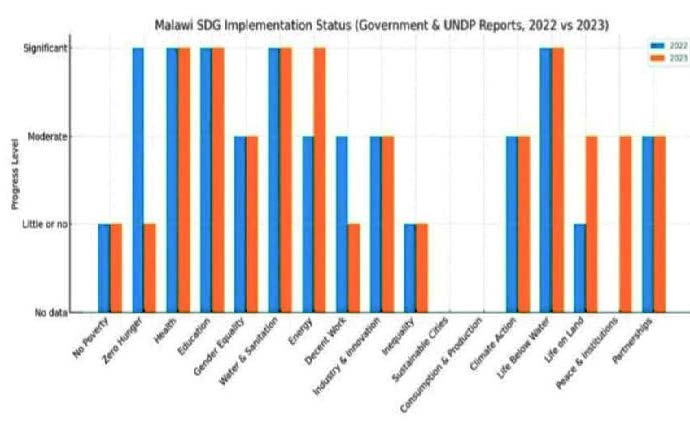
The progress across the 17 SDGs has been uneven and fragile, with some goals showing momentum while others stagnate or regress. The 2023 SDG Acceleration Report identifies five goals (2, 3, 4, 6, and 14) as registering substantial progress, while six others (5, 7, 8, 9, 13, and 17) are at moderate levels. However, Malawi continues to lag in SDGs 1, 10, and 15, which show little or no progress, and faces persistent data gaps for SDGs 11, 12, and 16, making monitoring difficult. The private sector has a critical role to play in supporting the government’s efforts to achieve the SDGs, particularly in areas such as infrastructure development, where malipiro a njira (access to roads) and malipiro a madzi (access to clean water) are essential.
The country’s development strategy, Malawi 2063, is currently being implemented under the First 10-year Implementation Plan (MIP-1), which aims to transform the country by 2030. However, Economics Association of Malawi president Bertha Bangara-Chikadza notes that failing to attain the SDGs will have serious spillovers on the country’s development, including missing the trajectory that was to transform Malawi by 2030. As such, it is essential for business owners and entrepreneurs to engage with the government and other stakeholders to support the implementation of the SDGs and MIP-1, and to explore opportunities for investment and growth in areas such as agriculture, manufacturing, and services. By working together, Malawi can accelerate its progress towards the SDGs and achieve prosperity and peace for all its citizens.
What are your thoughts on this business development? Share your insights and remember to follow us on Facebook and Twitter for the latest Malawi business news and opportunities. Visit us daily for comprehensive coverage of Malawi’s business landscape.
